
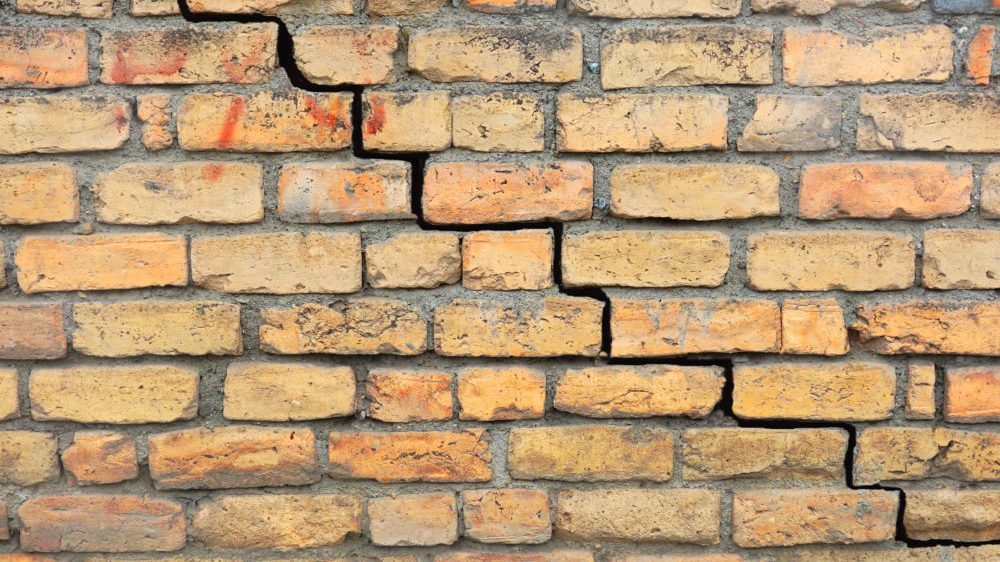
It’s the house repair every homeowner fears: foundation problems. Before you panic, here’s how to tell whether those scary looking cracks are “no big deal” or a sign of real trouble.
No worries. If you are living in a new construction home, expect minor settling that causes small cracks here and there. Hairline cracks that run straight along a sheetrock seam are an example. As the new house settles, the sheetrock ever so slightly pulls apart and the paper tape that covers the seam gets a very fine crack, almost undetectable. They’re not pretty, but not a major worry.
Other hairline cracks that can cause needless worry are those found on the stucco covering of the foundation slab. Most newer homes have a cosmetic veneer of nicer concrete spread over the foundation to provide a more attractive look than the actual concrete slab. Again, as the house settles, and as climate affects that veneer, it may develop hairline cracks. As long as it doesn’t expand and spread, it’s probably simple shrinkage.
Real problems. It’s time to start worrying if you see one of these seven signs of foundation issues:
- Larger than hairline cracks develop on the slab, not the concrete veneer. Or the veneer falls away revealing a crack in the slab.
- A bulge develops in the side of the foundation.
- A crack goes up the outside wall of the house, zigzagging upward, cracking brick and mortar.
- Cracks develop on the interior walls or ceiling that veer across the sheetrock.
- Doors and windows drag, stick, or are hard to either open or close. Window glass may crack. A gap between the door and frame may be visible when the door is closed.
- Floors begin to tilt. Use a level set at various points on the floor, or place a ball on the floor in different spots. It shouldn’t roll.
- An unexplained significant increase in water usage. If you haven’t increased lawn watering or household use, check all fixtures and sprinkler heads for drips and leaks. If you don’t find any sign of leakage, look at your water meter. Check it when no water is being used in the house. If the spinner continues to turn, water is flowing somewhere. Check the usage numbers before bed and again early in the morning. Look for water appearing in the basement, or around the outside of the foundation. Water could be leaking inside a wall or under the foundation. Radon gas from underground and surface water can also become a risk if it enters the home from these cracks.
What to do. Like shopping for any other home contractor, research online and ask friends for referrals. Evaluate them on the Better Business Bureau’s website at www.bbb.org. Look them up on review sites. Look for companies that have been in business a long time, decades if possible. A company in business for decades is doing things right.
Foundation evaluation. Expect the contractors you select to do a thorough inspection. Ask if they offer multiple repair methods. Ask if they are certified by professional organizations? Is their work evaluated by the International Code Council Evaluation Services or ICC-ES? Are they licensed and insured? Ask for copies of all these documents.
Request a copy of a scaled drawing of the house foundation and a warranty of all work. Request that the warranty be transferable to a new owner.
Cost. Types and severity of foundation problems vary, and types of soils around the country affect the price. Repair prices range from $1,800 for minor problems to more than $12,000 for major issues.
Buyer beware. Foundation problems are always something that should be on a prospective buyer’s radar. If the seller or the listing agent is aware of a foundation problem, they are legally bound to disclose it to potential buyers.

 Based on information from California Regional Multiple Listing Service, Inc. as of September 22, 2026 9:52 AM UTC This information is for your personal, non-commercial use and may not be used for any purpose other than to identify prospective properties you may be interested in purchasing. Display of MLS data is usually deemed reliable but is NOT guaranteed accurate by the MLS. Buyers are responsible for verifying the accuracy of all information and should investigate the data themselves or retain appropriate professionals. Information from sources other than the Listing Agent may have been included in the MLS data. Unless otherwise specified in writing, Broker/Agent has not and will not verify any information obtained from other sources. The Broker/Agent providing the information contained herein may or may not have been the Listing and/or Selling Agent.
 This information is deemed reliable but not guaranteed. You should rely on this information only to decide whether or not to further investigate a particular property. BEFORE MAKING ANY OTHER DECISION, YOU SHOULD PERSONALLY INVESTIGATE THE FACTS (e.g.square footage and lot size) with the assistance of an appropriate professional. You may use this information only to identify properties you may be interested in investigating further. All uses except for personal, non-commercial use in accordance with
 Last updated: September 22, 2026 9:32 AM UTC Property Information © 2026
  Bay East ©2026. CCAR ©2026. bridgeMLS ©2026. Information Deemed Reliable But Not Guaranteed. This information is being provided by the Bay East MLS, or CCAR MLS, or bridgeMLS. The listings presented here may or may not be listed by the Broker/Agent operating this website. This information is intended for the personal use of consumers and may not be used for any purpose other than to identify prospective properties consumers may be interested in purchasing. Data last updated at September
 The information being provided by Conejo Simi Moorpark Association of REALTORS ® ("CSMAR") is for the visitor's personal, non-commercial use and may not be used for any purpose other than to identify prospective properties visitor may be interested in purchasing. Any information relating to a property referenced on this web site comes from the Internet Data Exchange ("IDX") program of CSMAR. This web site may reference real estate listing(s) held by a brokerage firm other than the broker and/or
 The MLS™ I-Tech ® All information deemed reliable but not guaranteed. All properties are subject to prior sale, change or withdrawal. Neither listing broker(s) or information provider(s) shall be responsible for any typographical errors, misinformation, misprints and shall be held totally harmless. Listing(s) information is provided for consumer's personal, non-commercial use and may not be used for any purpose other than to identify prospective properties consumers may be interested in
